
 Back
Designed for dirt, tuned for data
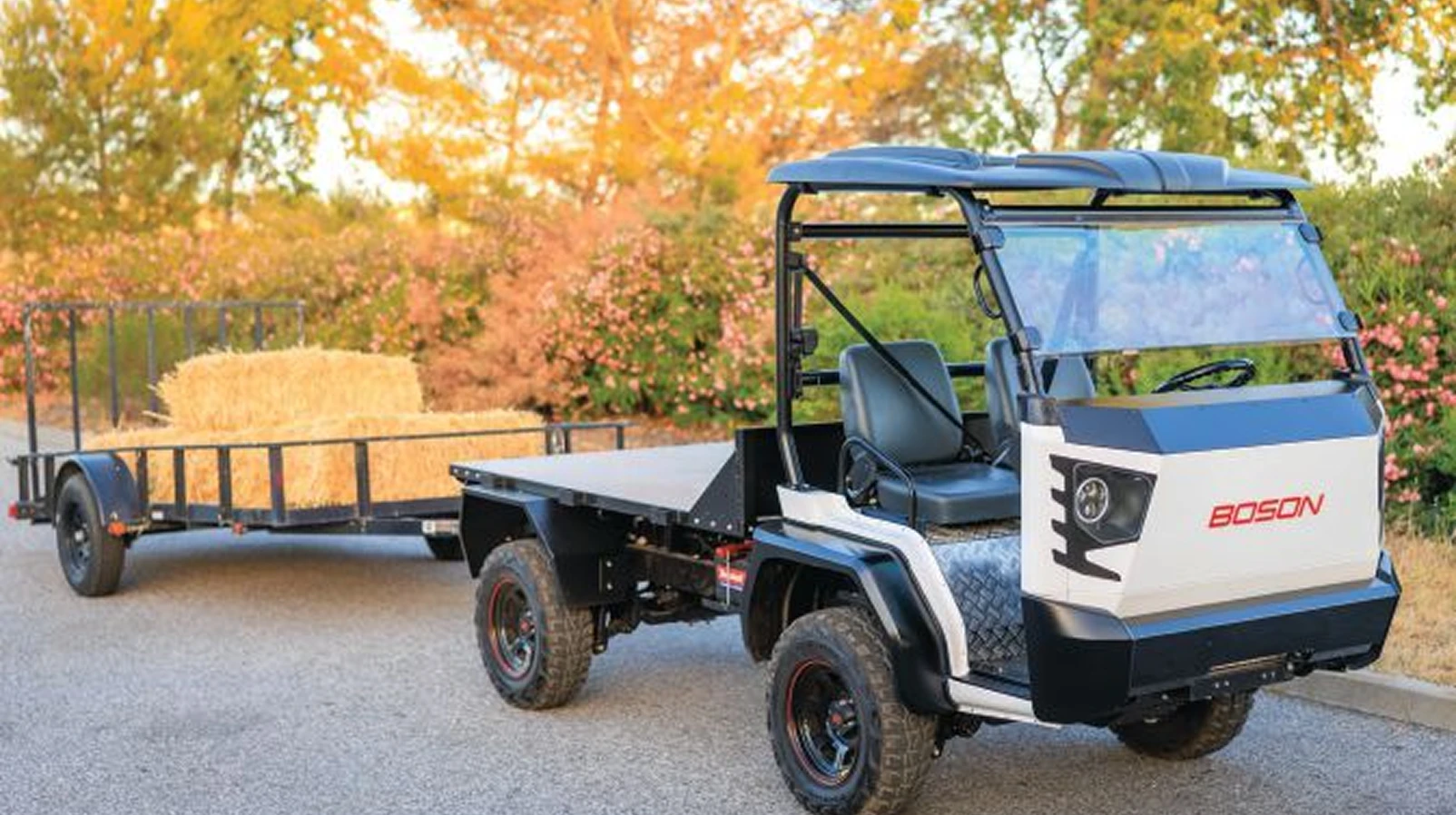
Boson Motors, founded in 2017 in San Jose, California, set out to build clean-energy mobility platforms for off-road, off-grid applications. Its flagship, the LX40, is a heavy-duty, all-electric utility vehicle purpose-built for agriculture, ranching and land management — dual 27 HP motors, a 2,000 lb payload and up to 72 miles of range per charge.
“We didn’t want to convert an existing UTV or modify a golf cart,” the engineering team explained. “We built from scratch — for payload, traction and autonomy.” The LX40 can be driven manually, remote-controlled from a browser or Android app, or put into autonomous mode for path-following and repeatable tasks.
RTK used to mean stress
Autonomy depends on a dual GNSS architecture: one receiver optimized for open-sky accuracy, the other for canopy environments like orchards and vineyards. “We needed centimeter-level corrections without installing base stations or managing subscriptions for every region,” the engineering team said. “GEODNET gave us that — and more.”
How GEODNET powers autonomy
GEODNET’s network delivers triple-band, multi-constellation corrections (RTCM 3.2) over NTRIP, so any standard GNSS receiver can use it without special integrations.
- Triple-frequency (L1, L2, L5) support with RTCM 3.2 and NTRIP compatibility.
- One configuration for all regions — the receiver auto-adjusts datum wherever the vehicle ships.
- Uniform, PPP-calibrated base station network — more than 20,000 stations in 140+ countries.
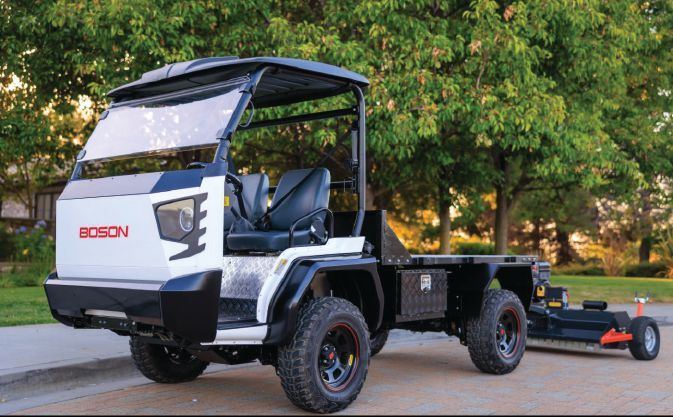
Boson bundles GEODNET RTK with every LX40 system, giving customers one-click activation and immediate accuracy — sub-20 cm straight-line and under 25 cm in curves. “RTK used to mean stress — buying hardware, troubleshooting signals, worrying about drift,” the deployment team said. “GEODNET eliminated all that. It just works.”
From theory to tractor
- Less overlap — in a 40-acre field, RTK guidance cuts fertilizer waste and fuel usage by 5 to 10% right away.
- Fewer hands — one customer replaced a diesel UTV and two workers with one person on a laptop and the LX40, making three 2,000 lb trips a day.
- Fast payback — farms report full payback in less than a season from fuel, labor and doing more with fewer resources.
- Lower TCO — lithium power costs under 20% of diesel per acre; no oil, no filters, fewer moving parts.
Bundled RTK, zero setup
- 1. Annual RTK via GEODNET: included with every LX40.
- 2. Region-agnostic NTRIP configuration — no local base station needed.
- 3. Supports all modern GNSS receivers, calibrated for sub-inch consistency.
- 4. Drive it, remote-control it, or set a route and let it run.
- 5. Coming next: RTK-guided implements for spraying, tillage, soil sensing and mowing, plus fleet swarming.

Centimeter-level corrections from 20,000+ stations in 140+ countries. RTCM 3.2 over NTRIP — works with any modern GNSS receiver, no base station required.

LX40 at a glance
- 96V / 19.4 kWh LiFePO4 battery; Level 2 charge to 80% in 5 to 6 hours.
- 72-mile range, 22 mph top speed, 27% gradeability, 2,000 lb payload and tow capacity.
- Users include almond orchards in California’s Central Valley, dairy farms, regenerative growers and research farms.